Thursday, October 2, 2008

Thousands of desperate women pushed and shoved to get at the relief food being handed out on the outskirts of this flooded city last week. Off to the side were the restaveks, the really desperate ones.

As woman after woman hauled off a sack of rice, a bag of beans and a can of cooking oil, the restaveks, a Creole term used to describe Haiti’s child laborers, dropped to their knees to pick up the bits that were inadvertently dropped in the dirt.

The hurricanes and tropical storms that have whipped across the western half of Hispaniola, the island divided between Haiti and the Dominican Republic, in the past month have laid bare the poverty and the deep divisions in Haitian society, where there are rich, poor and downright destitute.

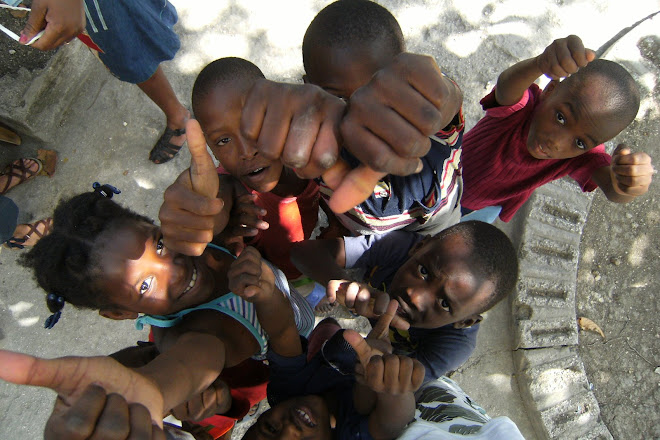
Nobody illustrates that last group better than the restaveks, the thousands of young Haitian children handed over by their poor parents to better-off families, most of whom are struggling themselves.

The term restaveks literally means “stay with,” and that is what the children do with their hosts, working as domestic servants in exchange for a roof over their head, some leftover food and, supposedly, the ability to go to school.

In practice, though, the restaveks are easy prey for exploitation. Human rights advocates say they are beaten, sexually abused and frequently denied access to education, since many host families believe that schooling will only make them less obedient.

Unicef estimates that 300,000 Haitian children were affected by the recent storms, many of them forced to relocate to shelters or rooftops.

But young Haitians suffered significantly even before the skies darkened during Fay, Gustav, Hanna and Ike, and more than 300 lives were lost. The country has the highest mortality rate for children younger than 5 in the Western Hemisphere, as well as a high death rate among infants and women giving birth. Just slightly over half of school-age children are actually enrolled in school. Attendance among restaveks, of course, is much less than that.

“Many of them are treated like animals,” said a United Nations official who spoke on condition of anonymity because she did not have authority to speak on the delicate issue. “They are second-class citizens, little slaves. You feed them a little and they clean your house for nothing.”

Gonaïves, a city in Haiti’s northwest, was no boomtown when the storms hit, having been devastated by a hurricane in 2004, from which it was still recovering. But that did not stop many poor families from taking in restaveks, the offspring of the poorest of the poor.

“Almost everybody has one,” said one of the women jockeying in the relief food line.

They are children like Widna and Widnise, twin 12-year-old girls who have been in the same Gonaïves home for the past two years.

They get up at dawn to fetch water, collect wood, cook, mop and clean. They watch as their host family’s two children, who are about the same age, eat breakfast and then go off to school. The twins eat nothing in the morning and stay home working.

The twins have it better than most, they say. They are hit on their palms if they are disobedient but do not receive lashings on their head, as they say many of the restaveks in nearby homes receive.

In the evening, they eat with the two other children and sleep on mats on the floor, just as those children do. They had shoes, unlike many of their contemporaries, although they lost those in the flooding.

But the girls said they did not like their situation. There is the teasing they get from other children, who tell them over and over that they will never grow up, that they will always be servant girls.

And they miss their mother, who works in the countryside as a domestic servant and visits the girls when she can. She tells them that she will bring them home as soon as she can afford to feed them.

“Our mother is too poor to take care of us,” said Widna, the more talkative of the pair, adding emphatically, “We don’t want to be restaveks.”

What they wanted most immediately on Thursday afternoon was food. Their host family had fled its flood-damaged home, leaving the girls alone. They arrived at a school in the Praville neighborhood where United Nations relief food was being handed out but were told that only women were allowed in line.

The pint-size girls sat off to the side until they noticed that some rice and beans were being dropped amid all the confusion. The girls looked at each other and then sprang into action with some of the other restaveks, scooping up the specks of food from the ground one by one.

Saturday, April 19, 2008

What is it like to be third.

PORT-AU-PRINCE, HAITI Hundreds of Haitians stood in long lines Saturday, just as others had walked for hours throughout the week to receive the U.N. and regional food aid pouring into the country after a spate of deadly riots.
But amid the tenuous calm, aid groups say they are just buying time — and long-term solutions seem remote in the desperately poor nation.

More than half of Haiti's nearly 9 million people live on less than $2 a day, but the sharp rise in prices has thrown some of those who could barely support themselves into the throngs of the utterly destitute.
Market stalls are piled with papayas and small bags of pasta, even in poor areas, but vast numbers of people simply lack money to buy them because global food and commodity prices have risen 40 percent over the past year.

At least seven people were killed in the food riots this month that cost Prime Minister Jacques Edouard Alexis his job.
The riots also were a setback to international efforts to stabilize the country, U.N. envoy Hedi Annabi said. U.N. peacekeepers came after a violent rebellion ousted President Jean-Bertrand Aristide in 2004.
"We now need to turn this around, draw the lessons from this crisis and move ahead," Annabi told The Associated Press.
The United Nations says it will distribute 8,000 tons of food and other aid in the next two months. Venezuelan President Hugo Chavez has pledged more than 350 tons of food. And U.S. President George W. Bush has ordered the release of $200 million in emergency aid to nations hit hardest by surging food prices — though it was not immediately clear how much Haiti would get.

Monday, March 24, 2008

Haiti, in the West Indies, occupies the western third of the island of Hispaniola, which it shares with the Dominican Republic. About the size of Maryland, Haiti is two-thirds mountainous, with the rest of the country marked by great valleys, extensive plateaus, and small plains.
Public education is free, the cost is still quite high for Haitian families who must pay for uniforms, textbooks, supplies, and other inputs. Due to weak state provision of education services, private and parochial schools account for approximately 90% of primary schools, and only 65% of primary school-aged children are actually enrolled. At the secondary level, the figure drops to around 20%. Less than 35% of those who enter will complete primary school. Though Haitians place a high value on education, few can afford to send their children to secondary school and primary school enrollment is dropping due to economic factors. Remittances sent by Haitians living abroad are important in paying educational costs.

Friday, March 21, 2008


Help Support Haiti.

https://www.paypal.com/cgi-bin/webscr

Click on link above

and Donate NOW!

ITS SAFE AND SECURE

Just $40/month

Can save a life like this.

Hatian Livin'

press play to watch video

---More than 200,000 Haitian children have lost one or both parents to AIDS

---300,000 Haitian children work as unpaid domestic servants in a system of bonded servitude, according to the U.N. Children's Fund.

According to figures released by the WFP, 22 percent of Haitian children are underweight because of malnutrition and 9 percent of them suffer acute malnutrition, while 50 percent of pregnant Haitian women are anemic.


Mighty to Save

press play to watch video

Be Mighty enough to save a Life. $40/mo = one life

Infant mortality rate:

total: 63.83 deaths/1,000 live births

male: 68.45 deaths/1,000 live births

female: 59.07 deaths/1,000 live births

(2007 est.)


Love Haiti More. Haiti is the poorest country in the western hemisphere, and the 3rd hungriest in the world. Most families live below the poverty line, and there is severe malnutrition. The difficulties of life such as low levels of community sanitation, improper housing, no electricity, no telephones, severe shortage of potable water and lack of transportation, contribute to the cycle of poor health, especially in the rural areas.
Natural hazards: Haiti lies in the middle of the hurricane belt and is subject to severe storms from June to October; occasional flooding and earthquakes; chronic droughts.